Restaurant social media marketing in Michigan is the difference between a packed dining room and empty tables on a Friday night. The restaurants filling seats in Sterling Heights, Shelby Township, and across Macomb County aren't the ones with the best food. They're the ones that show up on Instagram, post consistently, and make themselves visible where customers are actually looking.
You already know which restaurant I'm talking about.
It opened eight months ago. The food is fine. Nothing special. The kind of place where the truffle fries are frozen and the "house-made" ranch tastes suspiciously like Hidden Valley. But every Friday night there's a 45-minute wait. People are posting about it. The parking lot is full.
Meanwhile, you've been on that same block for years. Your regulars love you. Your kitchen runs clean. Your lamb shank could make a grown man cry. And last Friday? Half your tables sat empty.
You've thought about this. Maybe you've lost sleep over it. Something about it doesn't add up, because you know your food is better. And you're right. It is.
But nobody in this industry wants to say it out loud: the best food doesn't win. The most visible food wins.
That new spot across the street? They post beautiful food photos every single day. Their Instagram grid looks like a magazine. They reshare every customer story. They announce their Friday special on Wednesday with a photo that makes people start planning their weekend around it.
You? Your last Instagram post was six weeks ago. A blurry shot of a dessert special that's no longer on the menu.
This isn't a talent problem. It's a visibility problem. And it's fixable.
Does Social Media Actually Bring Customers to Restaurants?
Yes. According to Nation's Restaurant News, 73% of millennials and Gen Z visited a restaurant in the past three months because of something they saw on social media. For Michigan restaurants competing in dense corridors like Hall Road in Sterling Heights, consistent social media posting directly correlates with foot traffic, discovery by new diners, and higher weekend reservation volume.
Vague claims are worthless. So here are the numbers.
73% of millennials and Gen Z say they visited a restaurant in the last three months because of something they saw on social media. That's from a Nation's Restaurant News survey of over 1,100 diners. Not Yelp. Not Google reviews alone. Social media. They're scrolling, looking at food photos, checking the vibe, reading captions. And then they're picking the place that looks like it gives a damn about showing up online.
Sterling Heights alone has over 400 restaurants. Four hundred. That's the Hall Road corridor, the Utica dining scene, every strip mall and standalone spot from 14 Mile to 19 Mile. Your competition isn't just the place next door. It's every restaurant within a fifteen-minute drive that posts more than you do.
It gets worse. When someone searches "restaurants near me" and finds your Google Business Profile, the first thing they do is check your photos and your last post. If your Google Business Profile hasn't been updated in months, they don't think "oh, they're just busy cooking great food." They think you might be closed.
Not fair. But real.
What Happens When a Restaurant Stops Posting on Social Media?
A restaurant that stops posting on social media loses visibility in Instagram and Facebook feeds within two to three weeks. Potential customers who find a stale page often assume the business is closed or declining, and choose a competitor with recent activity instead. This effect, sometimes called the "dead page signal," costs restaurants customers they never know they lost.
Potential customers pick up on a signal instantly, even if they can't name it. We call it the dead page signal.
Someone hears about your restaurant. Maybe a friend mentioned it. Maybe they drove past. They pull out their phone and find your Instagram. The last post is from six weeks ago. The grid is sparse. The bio still says "Grand Opening Coming Soon!" from 2023.
What happens next? They keep scrolling. They find the place down the street that posted a sizzling steak video yesterday. Decision made. Reservation booked. You never even knew you lost that customer.
A dead social media page doesn't just fail to attract new people. It actively repels them. It tells them you've checked out, the business might be winding down, nobody's home. In an industry where trust is everything, a stale page destroys it before someone ever tastes your food.
And it doesn't take much to fix. You don't need a content calendar. You don't need a marketing degree. You need three photos a week.
What Should a Restaurant Post on Social Media Every Week?
A restaurant should post three types of content each week: one plated dish photo, one behind-the-scenes kitchen shot, and one dining room or community moment. This three-post-per-week framework requires only a smartphone and about fifteen minutes per day. No professional photographer or content calendar software is needed to maintain a consistent, effective restaurant social media presence.
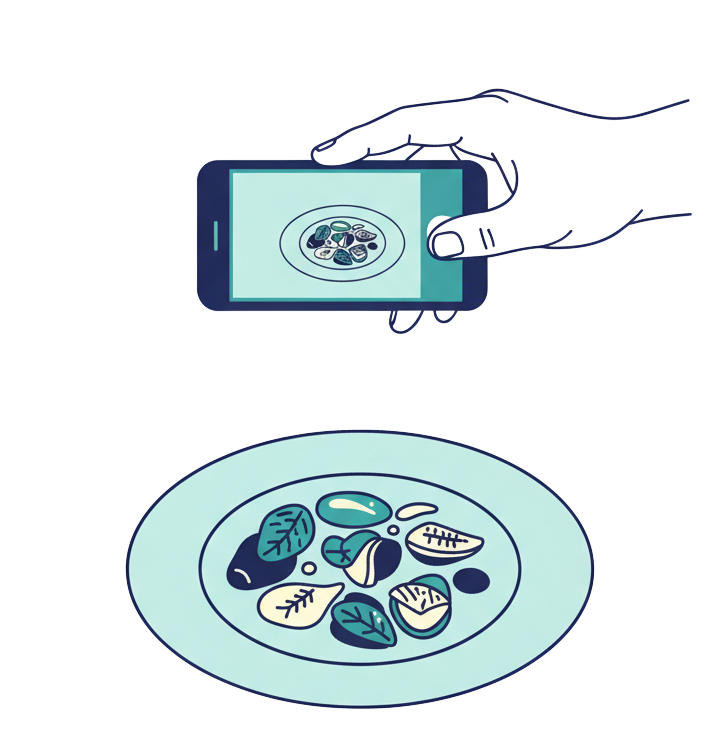
Forget everything you've read about "content pillars" and "engagement strategies." This is what actually works for restaurants. You could start tomorrow with nothing but the phone in your pocket. If you're still wondering whether your business even needs social media, the short answer for restaurants is yes — it's where your next customers are deciding where to eat.
1. The Plated Dish
One beautiful photo of a finished plate. Your best-looking dish. The Friday special. The seasonal item you're proud of.
No professional photographer needed. Set the plate near a window. Natural light does ninety percent of the work. Wipe the rim. Shoot at a 45-degree angle. Use portrait mode if you want a little blur in the background.
That's it. One photo. Takes two minutes between service.
2. The Kitchen Action Shot
Flames on the grill. Steam rising off a pot. Your line cook plating during the Friday rush. Hands working dough. The organized chaos that your customers never see.
This is the shot that separates you from chain restaurants. Applebee's can't post this. They don't have a story to tell. You do. That kitchen is where the magic happens, and people want to see it.
It doesn't need to be pretty. In fact, the grittier the better. A slightly chaotic kitchen in full swing looks more honest than a staged, perfectly lit counter with nothing on it.
3. The Full Dining Room
A wide shot of your restaurant when it's packed. Tables full. People laughing. Servers moving. The energy of a place that's alive.
This photo does something no caption can do: it proves people choose you. When someone sees a full dining room, their brain does the math automatically. "If all those people are there, the food must be good." Oldest trick in marketing, and it works every single time.
Don't have a packed dining room shot yet? Start with a well-set table, a warm-lit corner, a couple enjoying their meal (with permission). Build toward the full-house shot. It'll come.
What Are Good Restaurant Social Media Post Examples?
Effective restaurant social media posts combine a specific detail (dish name, night of the week, a regular's name), a sense of energy or emotion, and a local hashtag. The best-performing formats are the Friday special announcement, the behind-the-scenes kitchen rush, and the community moment featuring a real customer or staff member. For a deeper breakdown of content types, see our guide on what to post on social media as a small business.
Theory is useless without examples. Here are three actual posts a Macomb County restaurant could use this week. Change the details to fit your place.
"Friday night. Short rib over creamy polenta, red wine reduction, roasted carrots from Eastern Market. This one's been on the menu for three years because every time we try to take it off, someone riots. Kitchen opens at 4. Walk-ins welcome but it always goes fast. See you tonight. #SterlingHeightsEats #FridayDinner #HallRoadFood"
"Saturday night, 7:15 PM. Every burner going. Twelve tickets on the rail. This is what you don't see from the dining room. Three cooks, one tiny kitchen, and 47 people who all want their food at the same time. Wouldn't trade it. #BehindTheScenes #RestaurantLife #MacombCountyFood"
"Tony's been coming in every Tuesday since we opened. Same booth. Same order. Chicken parm, extra sauce, side salad, ranch on the side. Yesterday was his birthday so we brought out the cannoli with a candle. This is why we do this. Happy birthday, Tony. #RegularCustomer #UticaDining #SupportLocal"
Notice what those posts have in common. They sound like a person, not a brand. They mention specific details. They tell a tiny story. And they name the neighborhood. That's it. That's the whole formula. (The same principle works for barbershops and salons and auto body shops — local detail beats generic polish every time.)
Not sure what your restaurant's social media should sound like?
We'll write sample posts for your restaurant before you spend a dime. Real captions. Your voice. Your menu. Your neighborhood. If it sounds like you, we talk about a plan. If not, no hard feelings.
Get Your Free Audit →How Do Restaurants Get More User-Generated Content?
Restaurants generate more user-created content by placing a small table card or sticker near the register asking diners to tag the restaurant's Instagram handle. When the restaurant reshares tagged posts to their story, it creates a self-reinforcing loop: customers post, the restaurant amplifies, and other diners see it and do the same. This costs under $15 in printed materials and consistently outperforms paid ad campaigns for authentic social proof.
Every time a customer takes a photo of their meal and posts it, that's an ad you didn't pay for. It reaches their friends, their followers, their network. And it carries more weight than anything you could post yourself, because it comes from a real person with nothing to sell.
The problem is that most restaurants leave this to chance. They hope people will post. Sometimes they do. Usually they don't.
The fix costs almost nothing: a small table card or sticker near the register that says "Loved your meal? Tag us @yourhandle."
That's the entire system. A $15 print order from Vistaprint. Put one on every table or next to the register. When customers tag you, reshare their posts to your Instagram story. Thank them by name. This creates a loop: customers post, you share, other customers see it, they post too.
One restaurant owner in Clinton Township told us that a single table card generates more tagged photos per month than a $500 Facebook ad campaign ever did. The content is authentic, it's free, and it shows real people eating real food in your actual restaurant. No stock photo can compete with that.
Social proof compounds. Reviews work the same way. A gentle nudge at the right moment turns a satisfied customer into your best marketing channel.
How Much Does Restaurant Social Media Marketing Cost in Michigan?
Professional social media management for a Michigan restaurant costs between $297 and $800 per month with a local agency, which includes custom content creation, scheduling, and location-specific strategy. DIY posting costs nothing but requires about fifteen minutes per day. Budget AI tools run $49 to $99 per month but produce generic content. National agencies start at $1,500 per month, which is overkill for most single-location restaurants. Understanding your full website and digital marketing costs helps you budget realistically.
You want to know what this costs. Fair.
Doing this yourself costs nothing in dollars. It costs time. If you can commit to three posts a week, you can handle this with your phone, fifteen minutes a day, and the discipline to actually do it consistently.
If you can't (and most restaurant owners can't, because you're running a kitchen, not a media company), professional social media management for a restaurant in Macomb County runs between $297 and $800 a month with a local agency.
That gets you custom content, scheduling, and someone who knows the difference between Sterling Heights and Sterling, Virginia. Someone who'll reference the Utica Art Fair in your July posts and mention the Sterlingfest fireworks because people actually care about it.
National agencies and AI-powered services charge less, but they'll never mention Hall Road. They don't know your lunch crowd is mostly automotive workers from the nearby plants. They'll write "Visit us today!" captions that fit any restaurant in any city in America. Your followers will feel the difference, even if they can't explain why. And if you're still figuring out which platforms deserve your time, our breakdown of Facebook vs. Instagram vs. TikTok for Metro Detroit businesses covers that in detail.
What Happens If a Restaurant Ignores Social Media Entirely?
A restaurant that ignores social media loses discoverability in local search, surrenders customer attention to competitors who post consistently, and allows its Google Business Profile to stagnate — which pushes it lower in "restaurants near me" results. Over time, the compounding effect means fewer new customers, declining foot traffic, and growing dependence on a shrinking base of regulars. These are the same social media mistakes that hurt small businesses across every industry.
Nobody quotes you on the cost of being invisible.
Every week you don't post, someone discovers the restaurant down the street instead of yours. Every month your Google Business Profile sits untouched, you slide further down in local search results. Every season without fresh photos on your page is another season where that new spot with the mediocre food and the great Instagram fills tables that should be yours.
You didn't get into this business to be a social media manager. You got into it because you love food, you're good at it, and you wanted to build something. Nobody's asking you to become an influencer. But the people who would love your restaurant? They're making decisions on their phones. And right now, they can't find you.
That's not a marketing problem. That's a survival problem.
Frequently Asked Questions
Three to five times per week. One plated dish, one kitchen or behind-the-scenes shot, and one dining room or community moment per week keeps your page alive without burning you out. Consistency matters more than frequency. Three solid posts a week beats a burst of ten followed by three weeks of silence.
No. A modern smartphone with natural window light is enough. Wipe the lens, use portrait mode for plated dishes, and shoot from a 45-degree angle. Authenticity outperforms polish on restaurant Instagram accounts.
Place a small table card or sticker near the register that says "Loved your meal? Tag us @yourhandle." When customers tag you, reshare their posts to your story. This creates a loop: customers post, you share, others see it, they post too.
Three types of content weekly: a plated dish shot, a behind-the-scenes kitchen moment, and a packed dining room or community moment. These cover what people want to see — the food, the energy, and the proof that other people eat there.
Professional social media management for a Michigan restaurant runs $297 to $800 per month with a local agency. This includes custom content, scheduling, and location-specific strategy. Budget AI tools run $49–99 per month but produce generic content. National agencies start at $1,500 per month, which is overkill for most single-location restaurants.
The Bottom Line
The restaurant down the street doesn't have better food than you. They have better visibility. They show up where people are looking, and you don't. That's the whole mystery, solved in one sentence.
The fix is simpler than you think. Three photos a week. A table card that says "tag us." Captions that sound like a real person who actually works in your kitchen. A Google Business Profile that doesn't look abandoned.
You can do this yourself. Plenty of restaurant owners do, and they do it well. If you've got the time and the consistency, start tomorrow. This article isn't going anywhere.
But if you're the kind of owner who's already stretched thin, who spends fourteen hours a day running a kitchen and doesn't have another fifteen minutes for Instagram, that's not a personal failing. That's just the math of running a restaurant. That's exactly why Lakeside Creative Labs exists.
Either way, stop letting the place with worse food take your customers. You've earned those tables. Now make sure people can find you.